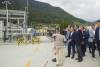
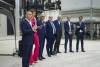
The President of the Lombardy Region, Attilio Fontana, accompanied by the Regional Councillor for Transport and Sustainable Mobility, Franco Lucente, visited the hydrogen production and distribution facility in Edolo today, built by FERROVIENORD as part of the H2iseO project. Also in attendance were FNM President Andrea Gibelli, FNM Board Member Fulvio Caradonna, FERROVIENORD President Pier Antonio Rossetti and Trenord CEO Andrea Severini, who, together with Councillor Franco Lucente, also visited the facility in Iseo.
Construction work on the two facilities was completed in June 2026, enabling the FNM Group to fully achieve the targets required to obtain PNRR funding for the project through the Lombardy Region. The funds allocated amount to €97.2 million out of a total of €362.4 million and relate to these two facilities and the hydrogen refuelling facility in Rovato, which has been operational since 2025.
Along the Brescia–Iseo–Edolo railway line, particularly on the sections between Brescia and Iseo and between Bornato and Rovato, dynamic acceptance tests of the hydrogen-powered trains are currently underway. Testing began overnight between 15 and 16 September. Once the dynamic acceptance testing programme has been completed, the trial operation phase will begin, during which the trains will undertake a further series of journeys along the line. These tests, required as part of the train authorisation process, will simulate all operating scenarios in preparation for the launch of commercial services in 2027.
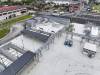
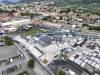
EDOLO FACILITY – The Edolo facility is located on land leased to FERROVIENORD and on decommissioned industrial sites (uncontaminated). The facility will produce hydrogen through electrolysis using electricity from renewable sources. The hydrogen will be stored and distributed through 2 dispensers operating at a pressure of 350 bar. Designed and built in compliance with the technical regulations governing hydrogen refuelling facilities under Ministerial Decree of 23 October 2018 and hydrogen production facilities using electrolysis under Ministerial Decree of 7 July 2023, which establish the relevant safety requirements and equipment standards, the facility includes a hydrogen production plant using electrolysis with a nominal production capacity of 1,644 kg of hydrogen per day (equivalent to 600 tonnes per year), a bay for receiving tube trailers, if required, and hydrogen storage facilities with a total capacity of 2,489 kg.
ISEO FACILITY – The Iseo facility is located entirely on land leased to FERROVIENORD, with the exception of a small area acquired from private owners, in the immediate vicinity of the existing Trenord depot. The facility will produce hydrogen from biomethane, recovering the CO2 generated in the process. The hydrogen will then be stored and distributed through 2 dispensers capable of refuelling two trains on two separate tracks at a pressure of 350 bar. Designed and built in compliance with the technical regulations governing hydrogen refuelling facilities under Ministerial Decree of 23 October 2018, which establish the relevant safety requirements and equipment standards, the facility includes a hydrogen production plant using steam reforming, with a nominal production capacity of 1,150 kg of hydrogen per day (equivalent to 420 tonnes per year), a bay for receiving tube trailers, if required, and hydrogen storage facilities with a total capacity of 1,450 kg.
“This project perfectly embodies the environmental transition we are striving for: a journey based on investment, innovation and competitiveness, capable of generating development,” says the President of the Lombardy Region Attilio Fontana. “As the Lombardy Region, we have supported H2iseO because institutions must enable the testing and assessment of the best technologies and then turn them into useful services. The Edolo and Iseo facilities demonstrate that major technological transformations can and must start at local level, creating expertise and excellence. This is the Lombardy model: delivering tangible innovation to provide real solutions. The environmental transition must be a driver of development, not an obstacle to growth.”
“The testing of hydrogen-powered trains in Lombardy is proceeding fully in line with the planned schedule, from the completion of the Edolo and Iseo facilities through to the planned start of operations next year,” emphasises the Regional Councillor for Transport and Sustainable Mobility Franco Lucente. “This is a highly innovative and technologically advanced project, consistent with the direction the Lombardy Region has been pursuing for some time towards increasingly sustainable and integrated mobility. Our goal is technological neutrality: from rail to road transport and waterways, we want to make the best possible use of all the latest technologies that can deliver significant benefits to citizens and freight transport. My department is at the forefront of these initiatives, promoting interconnected, digitalised and efficient mobility, with the aim of making Lombardy the driving force of Italy.”
“The completion of the Edolo and Iseo facilities marks another milestone towards the full implementation of the H2iseO project,” comments FNM President Andrea Gibelli . “Thanks to the decisive support of the Lombardy Region, the new hydrogen-powered trains will enter service starting next year. H2iseO is a project centred on innovation and sustainability, created to decarbonise mobility in Valcamonica and the province of Brescia. It is a model that can be replicated nationwide.”
“A big thank you,” says FNM Board Member Fulvio Caradonna, “goes to everyone in the Group and to our technical and institutional partners, particularly the Lombardy Region, who are working together to achieve these goals. Everyone’s commitment is bringing us closer to the launch of commercial operations.”
“FERROVIENORD,” emphasises its President Pier Antonio Rossetti, “thanks to the dedication and expertise of its professionals, has made an essential contribution to the completion of the facilities, as well as carrying out the other works required to bring a project of significant environmental and social value to fruition.”
THE PROJECT – Promoted by FNM, FERROVIENORD and Trenord, with the support of the Lombardy Region, the H2iseO project aims to develop a hydrogen-based economic and industrial supply chain in Valcamonica, starting with the mobility sector, initiate the area’s energy transition and contribute to the decarbonisation of a significant share of local public transport. The H2iseO project involves the introduction of 14 new hydrogen-powered trains to replace the entire diesel fleet currently operating on the line, the construction of hydrogen production and distribution facilities, technical and infrastructure upgrades to the stations concerned, and the construction of a depot and maintenance facility for hydrogen-powered trains. H2iseO was developed in response to a specific need: the gradual replacement of a diesel fleet operating on a non-electrified railway line, avoiding solutions that would have required extensive construction work, prolonged disruption to services and significant impacts on the local area.