

Our Commitment
to Sustainability
Strategic Plan 2024–2029
With the Strategic Plan 2024–2029, approved by the Board of Directors on November 18, 2024, the Group is pursuing an innovative, sustainable and inclusive development path, responding concretely to global competitiveness challenges.
Aware of its role in supporting the country’s ecological transition, and in a context where the population is increasingly concentrated in large metropolitan areas, FNM has defined a strategy focused on collective mobility, the ecological transition and digitalisation.
The Plan is built on two strategic pillars.
Sustainable Mobility
Through the development of interconnected, advanced and digitalised transport infrastructure capable of ensuring greater safety, accessibility and service quality.
Renewable Energy
To promote an efficient, decarbonised energy system aligned with the objectives of the national energy transition.
Strategic Plan 2024–2029
Objectives
Among the most significant environmental, social and governance (ESG) objectives to be achieved by 2029 are:
E-environment
Climate Change and Biodiversity
- ≈ 35% reduction in emissions generated by buses and corporate consumption [tCO₂eq vs. 2023]
- ≈ 650 GWh of renewable energy production from photovoltaic and wind power¹
- Adoption of a Transition Plan to Achieve Net-Zero GHG Emissions by 2050
- ≈ 830 tonnes/year of hydrogen production for rail mobility, with 3 hydrogen production plants and 4 railway hydrogen refuelling facilities, 5 motorway refuelling stations and 14 trains operating on the Brescia–Edolo line
¹ It should be noted that the target has been revised following delays in the launch of the FER-X auctions and regulatory developments. For further information, please refer to the 2025 Annual Financial Report.
S-SOCIAL
Own Workforce, Consumers and End Users
- Adoption of a Diversity, Equality & Inclusion Policy, in line with the European CER – Women in Rail Agreement
- 2 million square metres of areas involved in urban regeneration (FILI project)
- 25 km of additional railway tracks in high-density areas, contributing to improved service quality
- €1.5 million per km in investments related to motorway network safety and €270 thousand per km in investments related to railway network safety
G-Governance
Governance
- 50% of procurement by 2029 from suppliers with an ESG rating, through the adoption of a policy defining eligibility requirements and ESG evaluation criteria, together with training for relevant personnel
- Business Impact Analysis as part of the Business Continuity Management framework and the process of developing Business Continuity Plans
Morningstar Sustainalytics, a leading global provider of ESG risk ratings, assessed FNM Group’s ESG risk profile for 2025 as negligible, assigning a score of 8.3, compared with 6.3 in the previous year.
This result reflects the Group’s robust management of sustainability-related matters, further strengthening FNM’s position as a leading operator in Italy’s infrastructure sector. FNM ranks among the top 50 highest-rated companies globally out of more than 15,000 entities assessed, and fourth among 175 companies operating in the transportation infrastructure sector.
The score assesses a company’s exposure to ESG risks and its ability to manage them. FNM Group was assigned an overall low-risk profile, reflecting its strong commitment to quality and safety, employee health and well-being, and the generation of positive impacts for local communities.
Consistent with this assessment, the Group’s management of ESG matters was rated as highly robust and mature, underpinned by a strong commitment to environmental sustainability and supported by sound and well-structured policies. ESG reporting is fully aligned with international standards, while ESG governance is well established, with clear oversight at Board of Directors level.
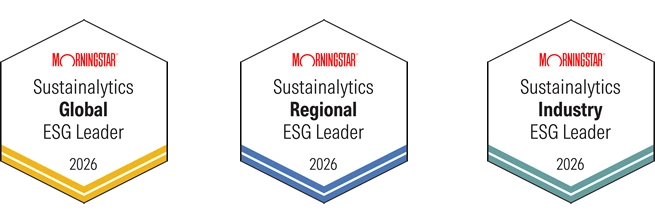
Awarded from 2025 onwards. The “ESG Industry Leader”, “ESG Regional Leader” and “ESG Global Leader” badges recognise companies based on Sustainalytics’ methodology. The recognition is based on publicly available data at the time of the assessment and may not fully reflect all aspects of a company’s sustainability strategy or actions. Companies are benchmarked against defined peer groups; the recognition should not be interpreted as an absolute measure of sustainability performance, nor as a guarantee of future results or performance.
Our Stakeholders
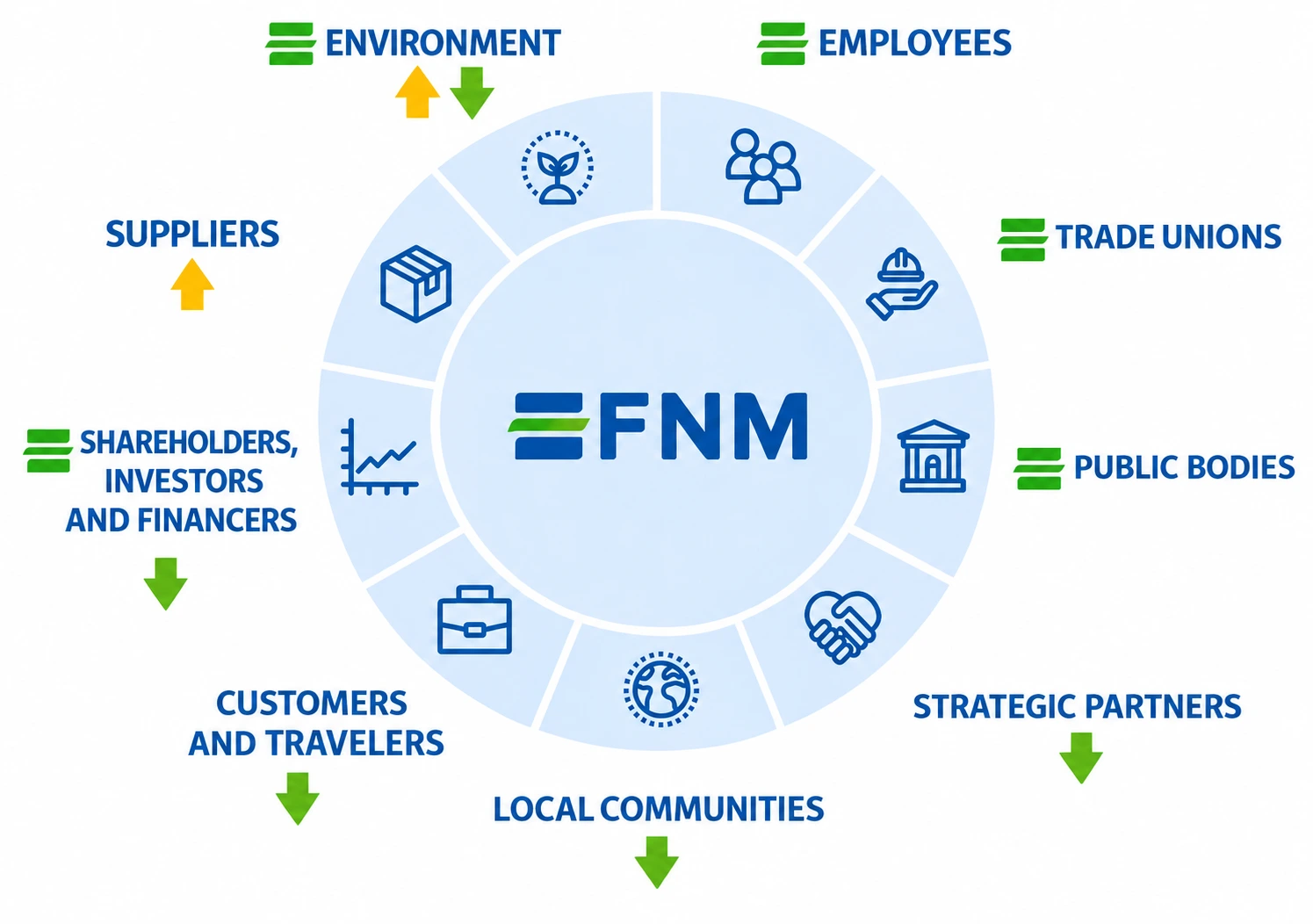
NM Group promotes ongoing, transparent and constructive dialogue with its stakeholders, actively engaging all stakeholder groups through dedicated engagement and listening initiatives.
The views, expectations and concerns gathered are regularly shared with the governing, management and supervisory bodies, contributing to the direction of the Group’s strategic decisions.
A central role in this process is played by the Double Materiality Assessment, conducted in accordance with the requirements of the Corporate Sustainability Reporting Directive (CSRD). This is a key tool for ensuring that corporate decisions are aligned with the priorities and needs of the various stakeholders, while further strengthening the Group’s ability to create long-term value.
Operations and Internal Processes
Positioning in the Stakeholder’s Own Operations
Upstream Value Chain
Upstream Positioning of the Relevant Stakeholder in the Value Chain
Downstream Value Chain

Contacts
Talk to the Sustainability Team
For any requests, information, questions, comments or suggestions regarding the Group’s Sustainability activities, our team is at your disposal.